New Testament History = Context
To correctly understand the New Testament
2025-10-15 by Steve Forkin
The New Testament is itself a historical account of the life, death and resurrection of our Lord Jesus. Likewise it is an account of the beginning of the Christian church. Nonetheless, Christianity did not begin in a historical vacuum. Understanding the secular history of the period in which Christianity developed gives us helpful clues as to how we are to understand some of the otherwise somewhat cryptic predictions about the second coming of Christ.
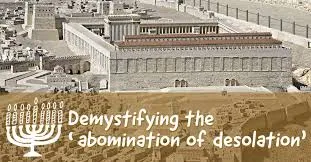
The New Testament is itself a historical account of the life, death and resurrection of our Lord Jesus. Likewise it is an account of the beginning of the Christian church.
Nonetheless, Christianity did not begin in a historical vacuum. Understanding the secular history of the period in which Christianity developed gives us helpful clues as to how we are to understand some of the otherwise somewhat cryptic predictions about the second coming of Christ.
Jewish historian Philo tells us that
around AD39 — not even a decade after the crucifixion of Christ, that then emperor Gaius — whose expeditions into Germany had made him sure of his own “divinity” — gave orders to his legionary forces in Judea to set up a gigantic statue of himself, directly in the Jerusalem temple.
This was not just a any statue. This was a declaration by the emperor, of his divinity and he was to be worshiped!
Anyone even remotely familiar with the book of Daniel, would recognise the implications of these orders. Realising the danger to the Jewish nation, it’s leaders sought to placate the emperor, claiming they had often offered sacrifices on behalf of the emperor, demonstrating their loyalty.
Gaius was not to be appeased: “You offered sacrifices for me, it is true, but you offered none to me”, proving his delusional belief in his own divinity was a deadly serious matter!
“Matters in Judea mounted to a crisis, the like of which had not been known since Antiochus Epiphanes set up the altar of Olympian Zeus on top of the great altar of burnt-offering in Jerusalem over two centuries before”. (ref.)
Herod Agrippa, before whom Paul was brought, before being sent to Rome (Acts 25 & 26) proved to have been born for this very moment. Taking his life into his own hands he wrote to the emperor, warning him that his demands of having this statue erected in the temple would lead to civil war in the whole of Judea.
History does not tell us, how well this letter was received, needless to say it was intercepted by a number of influential enemies of Gaius in Rome. Before the fateful event — planned for the year A.D. 40/41 — could take place, Gaius was assassinated, the fruit of one of the many conspiracies during this tumultuous period of early history.
These were the days, when the earliest written accounts — the synoptic gospels of Matthew, Mark and Luke — were being written.
It was very probable that during these anxious days of A.D. 40 that the Olivet discourse — found in all three of these gospels (Mark 13, Luke 21 and Matthew 24) — were penned. The authors would have remembered Jesus’s words of warning. “When you see the appalling sacrilege — the abomination of desolation — spoken of by the prophet Daniel, standing in the Holy place” (Matthew 24:15). Jesus continued to warn his disciples “then let those who are in Judea flee to the mountains” (Matthew 24:16)
The Jews were well aware of the term “appalling sacrilege = the abomination of desolation”, both from history and from the account of the Maccabees just two centuries earlier, never mind the prophecies in the book of Daniel.
The author of the gospel of Matthew, added the parenthesis “let the reader understand”. This phrase is in brackets in our Bibles, hinting that this is for emphasis. The reader of the gospel should understand, when you see this occur, be on your guard, Jesus’s prediction is about to come to pass.
There is an interesting feature in the Greek original that does not come across in the English translation. In Greek the substantive of the word for statue is (abomination of desolation) is in the neuter, whereas the participle in the passage is in the masculine. This is a feature that sadly is missed in translation. It’s actually incorrect Greek grammar and appears to have been done for emphasis.
The desolating sacrilege was personal, it’s not so much the statue — being neuter — that was going to be worshiped, but the emperor whom it portrayed, hence the masculine use. There could not be anything more abominable to a faithful Jew!
For that year, it was just a warning shot, but within the same generation, these words would be remembered again, when during the actual siege of Jerusalem in AD 70, the leader of the Roman armies, general Titus entered the Holy of Holies and ordered the most sacred part of the temple to be razed to the ground & burned.
I hope to have whet your appetite for learning history, to help you better understand the Bible. For those who would like to dig deep and understand how history helps us understand the whole of the Olivet Discourse, you may find my book on this very helpful.
https://www.amazon.com.au/End-Beginning-Unmasking-Predictions-Discourse-ebook/dp/B0DPF23N29
Given that I am a new author, it would really help me if you would be so kind and buy the book, read it and most importantly give it a review. Feel free to leave some comments.
My promise to you, if you do decide to read the book & give it a review, reach out to me and I will send you a free PDF version of one of my other books:
ref: “New Testament History” by FF Bruce, page 253.