Against Misreading Romans 13
Why the Apostle Paul Was Not a Statist
2025-12-01 by Steve Forkin
In this post I am writing a rebuttal of “Christian Nationalists” who have recently published a website with clear statements of their ideology. This can be found at: https://christiannationalist.com/ This website has a long trail of frankly objectionable, unhistorical and seriously unhinged assertions.
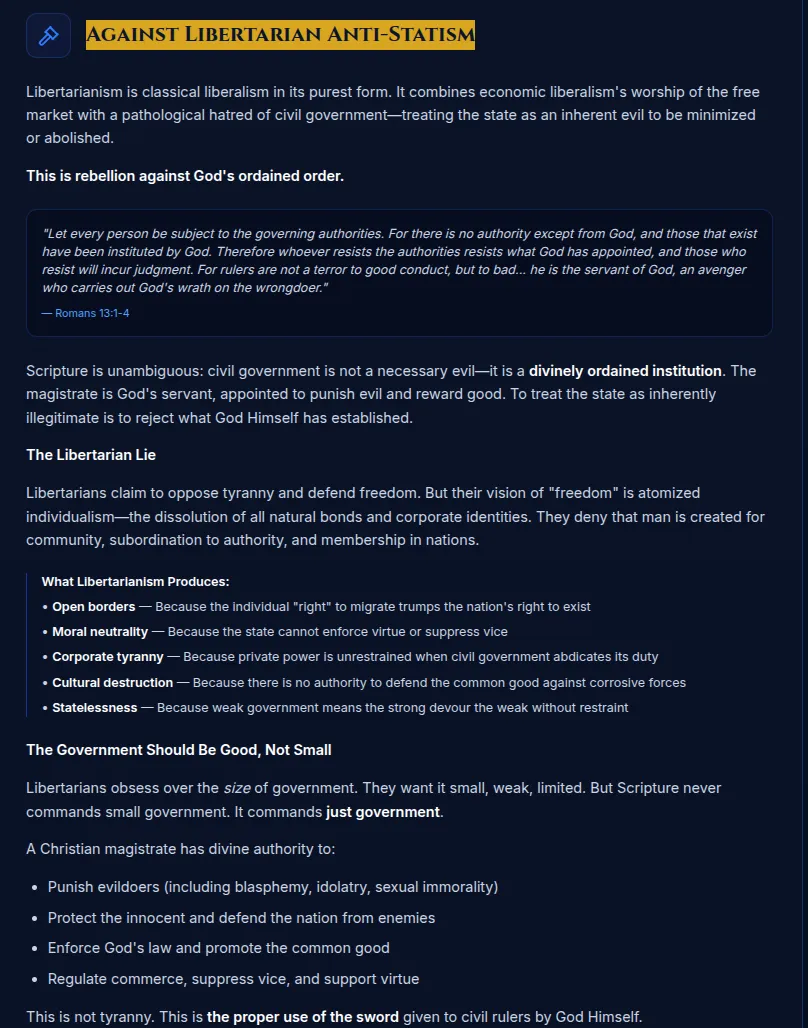
In this post I am writing a rebuttal of “Christian Nationalists” who have recently published a website with clear statements of their ideology. This can be found at: https://christiannationalist.com/ This website has a long trail of frankly objectionable, unhistorical and seriously unhinged assertions. In this short article I am simply rebutting one of their assertions that:
“Libertarian Anti Statism = Rebellion against God’s ordained order.”
Let’s first formulate this as a syllogism, so we can see clearly what is being stated:
P1: Romans 13:1-7 tells us the state is divinely ordained
P2: Romans 13:1-7 tells the state is to be obeyed
C: Christians who disobey the state disobey God — or to use their words “rebel against God’s ordained order”.
If both premise 1 and premise 2 are true, then the conclusion appears to logically follow, but are either of these premises actually true?
Before I get into the meat of why I think neither premise 1 or premise 2 is true, let’s momentarily just consider the period of time when Paul wrote this letter. Nero was the emperor of Rome at this time. Yes, it is true that his early days were not quite as wicked as his latter, nonetheless there is substantial evidence to suggest that he was one of, if not the worst persecutor of the Christian church ever to walk the earth.
Did Paul seriously suggest, Nero was to divinely ordained and to be obeyed?
Here is the section I am referring to. For the sake of detail, please take the time to read it on their website — this image isn’t the full version.
For the uninitiated, at first glance the arguments appear to carry quite some weight, but the sincere student will recognise some serious inconsistencies. Let’s look at them.
Few verses are invoked more frequently to defend governmental power than Romans 13:1–7. The familiar argument runs this way: since the powers that be are ordained by God, Christians must submit to the political state, in this instance a Christian Nationalist state, but a monopolistic state nonetheless.
This interpretation has long been used to sanctify empire, justify obedience to tyranny, and mute Christian dissent. Yet it rests on a profound category mistake: it reads state where the text speaks only of authority. During the rise of the 3rd Reich, Hitler used this very same argument to beat the German church into submission. The faithful pastors saw through this ruse, and joined together to form a resistant church, that refused to bow to tyranny!
The Apostle Paul was not baptizing Leviathan. He was affirming that lawful authority—the moral power to punish evil and reward good—is ordained of God. That principle can and does exist without a coercive monopoly called the state. Indeed, as both Scripture and libertarian natural law theory affirm, just authority arises from God’s moral order, not from bureaucratic structure.
Paul starts out by saying: Let every person be subject to the governing authorities (ESV, Romans 13:1)
The Greek term translated “authorities” is ἐξουσία (exousia)—meaning legitimate authority or delegated right. Paul did not use βασιλεία (basileia) for kingdom, nor ἄρχων (archon) for ruler.
His concern is not political organization but moral legitimacy.
Authority (exousia) in Scripture always derives from service to God’s order, not from the sheer fact of control. Just as a parent, judge, or shepherd wields moral power only within divinely ordained limits, so too a civil magistrate.
Paul’s logic is ontological, not institutional. He describes how lawful authority operates under God, not which human system exercises it.
Think this through with me for a moment. If you conclude that the authority carries with it unlimited exercise, and remembering that Paul uses the same term when he claims men are to be the head of their wives & families, then you have endorsed the wife beater and the child abuser, and you have no way out of this trap!
Let’s use a different analogy, that of employer and employee. The employee is contracted to do certain tasks. The authority of the employer is legimate when he acts within the remit of his contractual agreement with the employee. One can say his command carries legitimate power and is binding upon the employee when the command is within the remit of the contract. Should the employer demand the employee carry out a duty that is not part of the contractual agreement, then said command carries no authority.
If that didn’t sink in, re read it slowly. It’s important to grasp how authority works and when it is legitimate and when not.
Now let’s take this same example back to the text and see whether there is in this passage something akin to the contractual agreement between the employer and the employee.
Paul continues in verse 3 & 4: For rulers are not a terror to good conduct, but to bad. Would you have no fear of the one who is in authority? Then do what is good, and you will receive his approval, for he is God’s servant for your good. But if you do wrong, be afraid, for he does not bear the sword in vain. For he is the servant of God, an avenger who carries out God’s wrath on the wrongdoer.
It seems to me we have here a clear set of boundaries in terms of the divine appointment of the civil magistrate, namely to reward good and punish evil. That is the only remit of the civil magistrate. Interestingly the article claimed the magistrate has all sorts of powers like regulate commerce, suppress vice & support virtue. None of these are to be found in this passage. Suppression of vice, would be things like forbidding drinking of alcohol for example. How can we tell whether Paul’s argument about punishing evil falls includes things like punishing someone for drinking alcohol?
The simple answer here is to do a detailed study of God’s law and to see what kind of transgressions were punished civilly and which kind of transgressions where dealt with in other ways, including the ceremonial laws in the Old Testament. The honest student will find that the general principle of punishment in the Torah related to crimes where is a victim, such as theft, rape and murder. It is likely that Paul when referring to good and evil is also basing this on the principle of Lex Talionis as seen in Genesis chapter 9 after the flood.
The suppression of vice — as Libertarians realise — is also the most futile of all aspirations of the state. Just look at the history of the prohibition in the US. No doubt people meant well who advocated against all consumption of alcohol. The truth may surprise you, but the consumption of alcohol increased ten fold during the prohibition, and it created the seed bed of some of the worst crime gangs in US history.
Interestingly Paul chose the term minister, Diakonos—the same word Paul uses for a deacon— that signifies service, not sovereignty. The magistrate’s task is to defend the innocent and restrain the wicked; his legitimacy vanishes when he terrorizes the righteous.
This principle demolishes any claim that might makes right. As the reformer Theodore Beza observed, The magistrate is of divine institution, but tyranny is of the Devil.
Consequently, blind submission to unjust men is not Christian obedience—it is idolatry. Scripture repeatedly condemns rulers who exalt themselves above God’s law. Psalm 94 calls them thrones of iniquity that frame mischief by statute. Romans 13 prescribes allegiance to justice, not servility to power.
What we have observed so far is this:
There is no state in Romans 13:1-7, just civil governance. In a libertarian, stateless society — the kind Christian Libertarians advocate for — there would naturally be civil magistrates, arbiters for justice, much in the same way we have them in most modern, western nations today. The fundamental difference being that the modern “state” has a monopoly on “violence” in the sense that, there is no recourse against the state, there is no guardian to guard the guardian, since the fox is in charge of the hen house. The modern state at it’s core, is at odds with any kind of proper moral standard of justice. It is inherently unjust since there is no way to deal with the situations where it would, could and indeed does act unjustly.
Let’s repeat the earlier premise 1:
P1: Romans 13:1-7 tells us the state is divinely ordained
Clearly this is false and with it the conclusion that Christians who disobey the state disobey God, is false. Now let me be really clear here, I am not advocating for Christians to disobey the law of the land at will. There are plenty of biblical and natural reasons why Christians — at least in principle — should be law abiding. What I am saying is that there are times when disobedience is right, and in fact sometimes resisting statist tyranny is in fact obedience to God. That raises the question of How, and this article would get far too long, for me to articulate that here.
Can I recommend you read my book on this subject: Slaying the Dragon, Resistance to Tyranny is Obedience to God.
Slaying the Dragon, Resistance to Tyranny is Obedience to God https://www.amazon.com.au/Slaying-Dragon-Resistance-Tyranny-Obedience-ebook/dp/B0C5X157HN.
What about the second premise?
P2: Romans 13:1-7 tells the state is to be obeyed
Again, it bears repeating, there is no state in this passage, and further more obedience is only demanded to properly appointed divine authority that is limited in the ways Paul prescribed in verses 3 & 4.
Why then did Paul write this passage to the church in Rome? Some historical context is helpful:
Paul wrote to Christians in Rome around A.D. 57, under Nero’s early reign. The church had no political power and was often accused of rebellion. Paul’s pastoral aim was to prevent unnecessary persecution by urging peaceful conduct under pagan administration.
This context matters. Paul was not outlining a theology of the state; he was explaining how believers could live morally within a hostile empire. Much like Jeremiah’s letter to the Babylonian exiles, his counsel was pragmatic: “seek the peace of the city.”
Christ’s own teaching mirrors this stance. When He said, Render unto Caesar the things that are Caesar’s, and unto God the things that are God’s (Matthew 22:21), He made a jurisdictional distinction—Caesar’s realm is temporary and limited, God’s is absolute. Coins bear Caesar’s image; human beings bear God’s.
Therefore, conscience and worship remain forever outside the emperor’s reach.
I will leave you with some thoughts on Libertarianism — just so you can see clearly why the Christian Nationalists not only get Paul’s words wrong, they also misrepresent the ideas of Libertarianism:
Libertarian natural-law theory provides an exact analogue to Paul’s framework. Law precedes government. Human institutions do not create morality; they are judged by it.
A ruler acts lawfully only when defending natural rights—life, liberty, and property—which flow from humanity’s creation — the imago Dei. This moral order is identical to the biblical commands Paul assumed: “Thou shalt not kill,” “Thou shalt not steal,” “Thou shalt not bear false witness.”
Under this understanding, the magistrate rightfully exists only as a protector of justice—a localized guardian of peace—not as a monopolist of coercion. A polycentric or voluntary system of local judges, private law, and moral mediation fulfills Romans 13’s mandate as completely as any civil empire, and in fact more faithfully so.
Libertarian ethics therefore do not reject authority; they reject authority’s counterfeit.
The real issue with Christian Nationalism when it comes to the state, is the same as with the folk on the left — Socialists, Marxists, Communists — each have ideals as to who is defrauded of their rights — for those on the left it is always the power dynamic of “oppressed versus oppressor” — for those on the right it is their own tradition, heritage and yes even Christian values. There is truth in all of these, but the wielding of raw state power to achieve their aims, is what causes the worst of all problems.
The Christian ideals start with the individual and his heart. The real issue is the sin that lies within the hearts of men, and politics is never the solution or the answer.
When Christians begin to lose sight of the centrality of the gospel and begin to want to wage war against their “enemies” using the sword of the state, they have ceased to follow Christ and begun to create a false religion with a false God, namely the state. That state will have sinful men at it’s helm and sooner or later will wreak havoc.
The deep conflict between Christian libertarianism and modern statism boils down to this: Service versus Sovereignty.
Romans 13’s magistrate is a minister of God, accountable and limited. The modern secular state is a self-proclaimed savior, jealous of all competitors, demanding loyalty and funding without consent. It claims the right to define good and evil. That is not divine order—it is blasphemous parody.
When Rome demanded worship of Caesar, Christians refused. When totalitarian governments claim moral authority today, the same principle applies: obedience to God precedes obedience to men.
Thus, libertarian resistance to coercive power is not rebellion; it is fidelity to Paul’s own logic.
A free and moral people obey authority willingly when it serves good. Not more and not less.