The Fall of Babylon...
A hellish equivocation?
2026-05-10 by Steve Forkin
The fall of Babylon is described in several chapters of the Book of Revelation, each of which are a recapitulation. Misunderstanding the language used to describe the event has consequences.
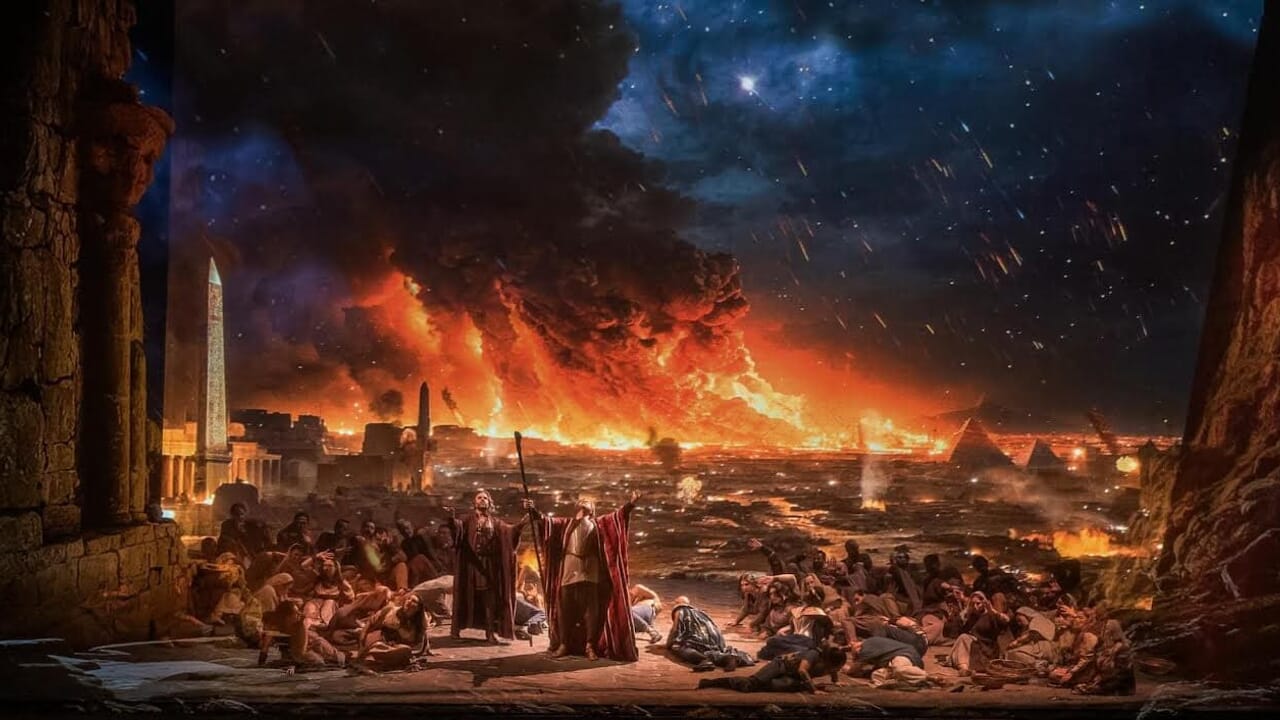
The Fall of Babylon - A Hellish Equivocation?
The fall of Babylon is described in several chapters of the Book of Revelation, each of which are a recapitulation. Misunderstanding the language used to describe the event has consequences.
A few years ago, I spent an entire year, reviewing every major journal article and all the recommended books that deal with the subject of hell, in particular the nature and duration of it. If there was one thing that stuck out to me the most in my reading of all the works written in support of the ECT – also known as the traditional or Eternal Conscious Torment – view on Hell, it is this. The two major proof texts rolled out time and time again as the foundation of this view are found in Revelation 14 and Revelation 20.
Brian Dempsey in his “Rethinking The Traditional Interpretation of Revelation 14:9-11” summarises the traditional view like this: “The traditional interpretation typically centers on three main features in the text. First, the reference to ‘torment… with fire and sulfur’ (v. 10) is taken as a description of ongoing conscious suffering. Second, the statement that ‘the smoke of their torment goes up forever and ever’ (v. 11) is read as a declaration of unending duration. Third, the phrase ‘they have no rest, day or night’ is seen as an expression of obvious uninterrupted and irreversible agony”
For the majority of Evangelical Christians today, the description of suffering and torment in Revelation 14:9-11 is the most compelling confirmation of the traditional, ECT view of the eternal punishment of the wicked. The image of fire & sulphur and the duration described by the terms “forever and ever” is sufficient for them to accept their view. This passage is the single most used proof text by which other texts are interpreted. Book after book & article after article has confirmed this to me.
Revelation chapter 20 speaks of the Devil, the False Prophet and the Beast being thrown into the lake of fire where they will be tormented night and day forever and ever. Finally at the end of the chapter death and hades are also thrown into the fire followed by anyone who was not written in the Book of life. The form of punishment of the latter group is not described in the way the fate of the devil, the beast and the false prophet are described. It’s also noteworthy that “death & hades” are not beings or groups of beings, especially not “things” you can throw as such. The language is clearly symbolic, and yet this together with Revelation chapter 14 that is more explicit, forms the very basis for the doctrine of eternal conscious torment. #ref1
I am currently working on a book on the subject of hell & with that on a detailed review of Revelation 14, 18 & 20.
You are getting this as a teaser.
GK Beale does a fantastic job in his Commentary on Revelation. He is one of the many commentators who demonstrates that the book is not a synchronous list of events, but rather a succession of recapitulations of a smaller number of events. I have confirmed with commentators from all the main three views of Revelation – Preterist, Idealist & Futurist – and all seem to agree on the idea of recapitulation, even if they don’t all agree on the number or the intricate details of the recapitulations. #ref2
We have a fairly solid consensus that the “Fall of Babylon” in Revelation 14 is repeated in chapter 18, from a different perspective, and giving us different details.
The fall is introduced in both chapters with this declaration: “Fallen, fallen is Babylon the Great” (Rev 14:8, Rev 18:2).
This alone should alert us to several important things:
- We should interpret both passages together.
- Difficulties in one passage are likely explained or given more light, by reviewing the other passage.
- We should not interpret one passage in a way that will contradict the other.
Whatever your views of the Book of Revelation are, I think it is prudent to avoid the mistake of claiming the Book of Revelation represents clear passages on a doctrinal issue and other passages should be regarded as obscure by comparison with the ones found in Revelation. Passages like, Romans 6:23, “For the wages of sin is death, but the free gift of God is eternal life in Christ Jesus our Lord”, are easily understood, and should be viewed as “clear” rather than obscure.
The Protestant Reformation did not invent, but certainly reclaimed and restated the maxim of “Interpret the obscure by the clear and not the clear by the obscure”.
Revelation chapter 14 is filled with obscure statements, that should very much give us pause and caution:
Only 144,000 thousand appear to be redeemed.
- “No one could learn that song except the 144,000 who had been redeemed from the earth” (Rev 14:3)
To be redeemed, means not have been defiled with women, indicating that only men are saved.
- “these who have not defiled themselves with women, for they are virgins” (Rev 14:4)
God harvests the righteous with a single swing of a giant sickle.
- “So he who sat on the cloud swung his sickle across the earth, and the earth was reaped.” (Rev 14:16)
The winepress [of God’s judgment] causes so much blood to flow it reaches the height of almost 2 meters!
- “And the winepress was trodden outside the city, and blood flowed from the winepress, as high as a horse’s bridle” (Rev 14:20)
It seems to me that it is fraught with error to claim Revelation 14:9-11 are to be taken literally in the sense that the Eternal Conscious Torment camp does, whilst claiming the remainder of the chapter is symbolic, what it clearly is.
It’s really helpful at this point to view chapters 14 & 18 side by side and mark out the similarities & review the difficult statements in light of the common thread in both.
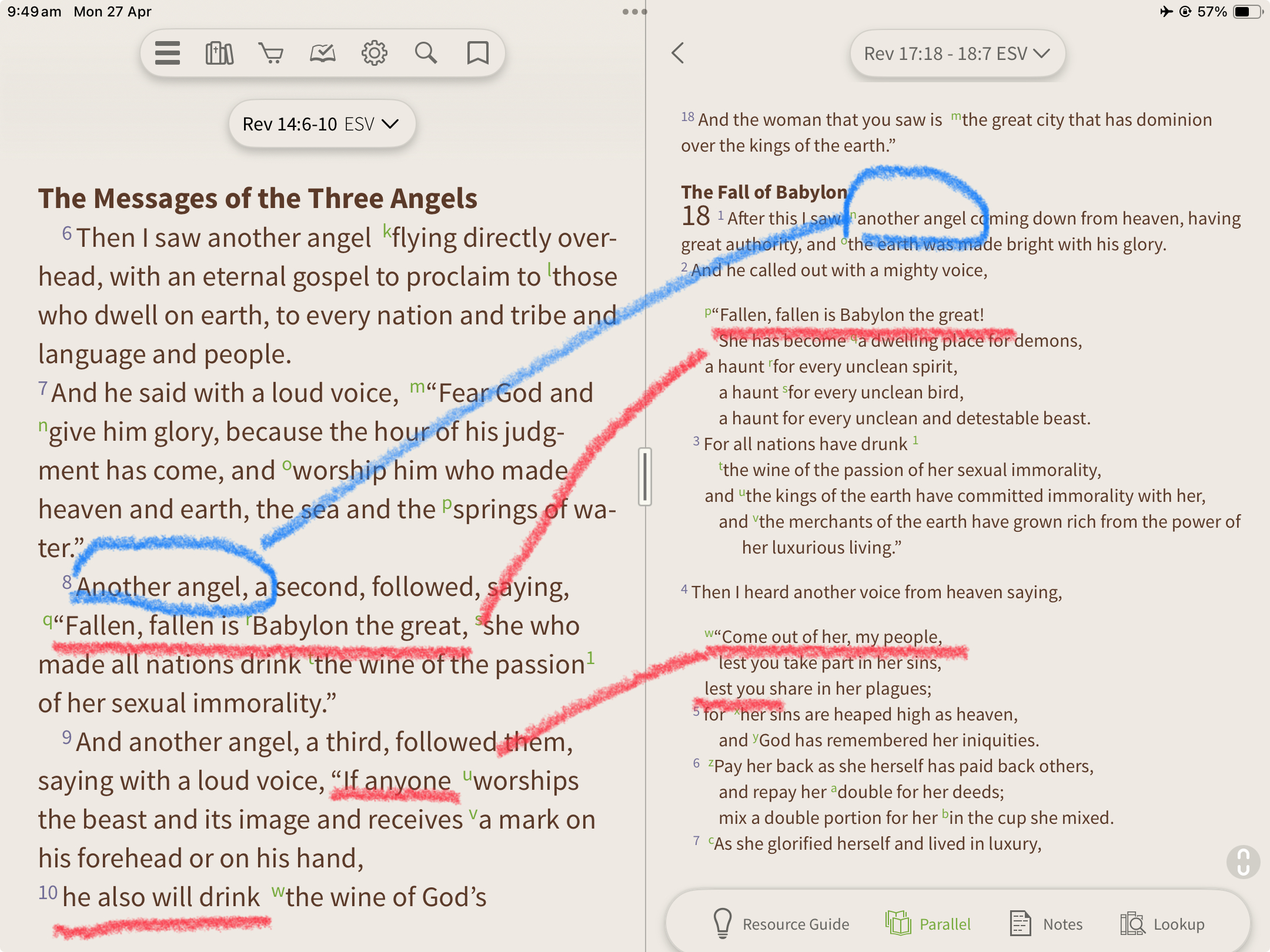
Let’s start by pointing out the similarities:
- The declaration “Fallen, fallen is Babylon the Great” - Rev 14:8 + 18:2
- “All nations drink the wine of the passion of her immorality” - Rev 14:8 + 18:3
- The call to come out of her - to avoid God’s judgment on her is repeated in both - Rev 14:9 + 18:4
- In both passages those caught in Babylon’s judgment will experience torment & suffering - Rev 14:10 + 18:7
But then there are also stark differences – details that appear initially to be total opposites?
- In chapter 14 - those judged are tormented for ever and every day and night - Rev 14:11
- WHEREAS
- In Chapter 18 - those judged are “burned up with fire” and their judgement is in a single day and a single hour - Rev 18:8, 10
Here are some features where chapter 18 gives clarity on chapter 14:
-
In chapter 14 the smoke of their torment goes up forever and ever - see Rev 14:9, leading traditional interpreters to claim this event is actually not just the fall of Babylon by the eternal state of the wicked, even though that is unstated in the passage.
-
In contrast in chapter 18 we see that the onlookers who are viewing the fall of Babylon from a distance, are the ones who see the smoke of the torment rise.
-
The mourning in chapter 18 is something onlookers do standing a far distance away from the city of Babylon.
-
The additional clarity on the event, in particular how those onlookers in chapter 18 view the event, raises a serious problem with the ECT view of verses 9-11 in chapter 14. If verses 9-11 is a depiction of the final judgment, with the righteous going to be with Christ & the sinners cast into hell, there is no room for a third group of people, i.e. these onlookers that clearly where trading with the beast, i.e. it’s natural not to read them as being a part of the righteous, but rather then unrighteous. The ECT rendering therefore leads to a sutuation where some sinners – namely those who took the mark of the beast & remained within Babylon – are cast into hell forever, whereas other sinners – namely those who merely traded with the beast & mourn the loss of the beast & the fall of Babylon continue to live, but mourn the final judgment from a distance.
-
Clearly the ECT camp does not believe this, but “wooden literal” exegesis of the apocaplyptic language in Revelation 14 leads to these problematic consequences.
Is that really how we are meant to read the book of Revelation?
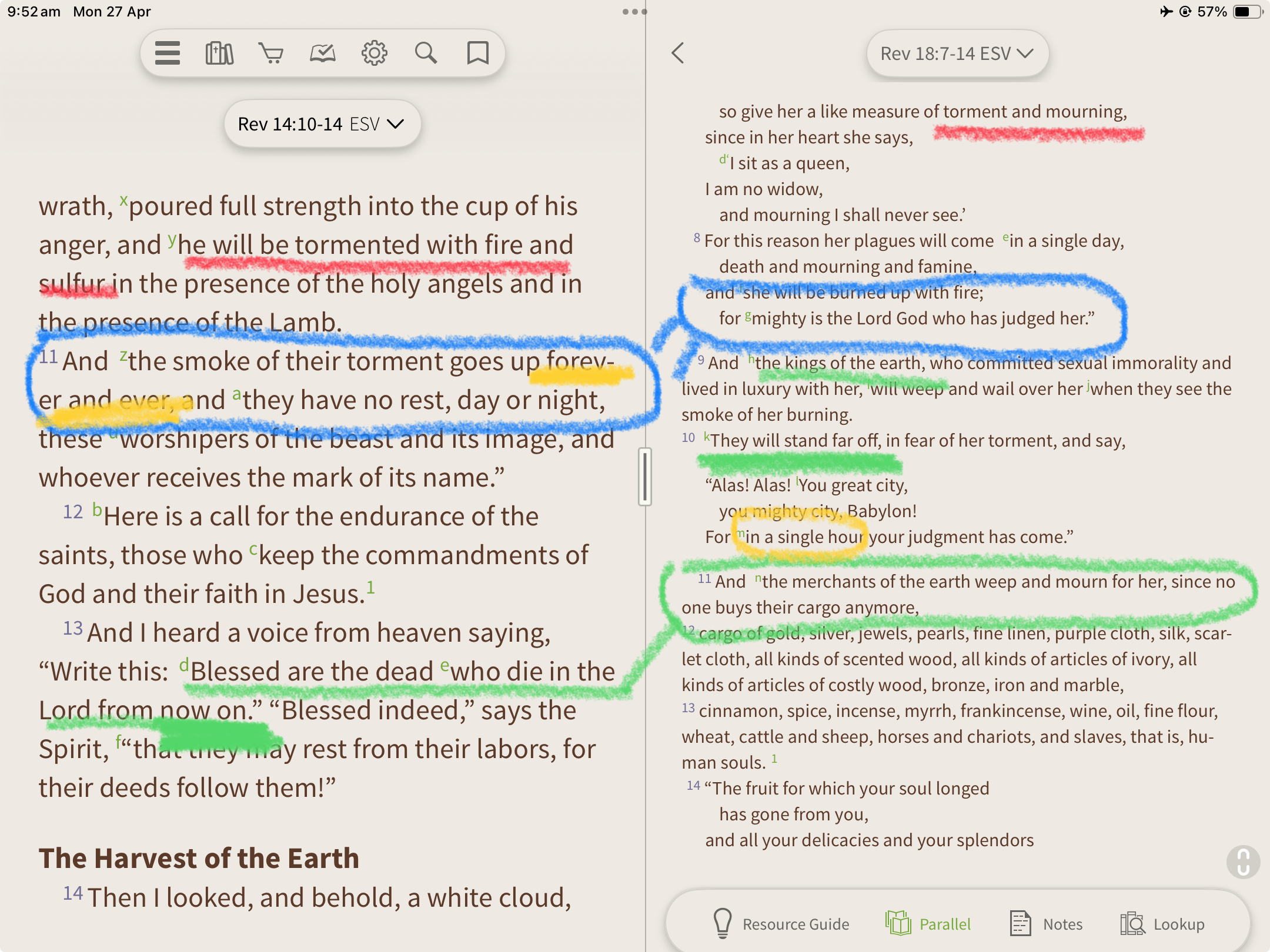
Viewing these two chapters side by side – regardless of whether you now view the book broadly from a preterist or a futurist perspective – certainly highlights some serious issues with asserting that verses 9-11 are about the eternal state of the wicked.
All Christians broadly agree that the sinners will be cast into hell, after the final judgment. That is the final Biblical event for the wicked before facing their eternal fate. After this, the righteous will enter into eternal life with Christ.
But, as we have already seen there are discrepancies in the two renditions of the event, that the traditional interpretation simply cannot do justice to. Here is yet another one of these pesky problems that arise from an overly wooden literalising of the event, rather than letting symbols do their job
- Chapter 14 tells us “Blessed are the dead who die from now on” – the natural reading of this statement is that it follows the event of the fall of Babylon. This however raises a massive hurdle with the ECT view that claims verses 9-11 are about the final judgment. If that is so, how do they account for John applying a blessing on those who “die from now on” i.e. after the final judgment. Wasn’t that supposed to be the event that finishes death forever, i.e. no one dies anymore? To claim that verses 9-11 are about the eternal state of the wicked – rather than an apocalyptic rendering of the calamatous fall of Babylon – forces one to read verse 13 in an unnatural way. I am not saying that the problem the ECT camp has with verse 13, is the clinching piece of evidence, but rather that the cumulative effect of all the issues raised by comparing chapter 14 with chapter 18 certainly does!
How then are we to interpret verses 9-11 of Revelation 14?
-
Firstly let me say that my aim with this article was not to give a detailed exegesis of chapter 14 of Revelation. For that I would heartily recommend the work of GK Beale for example. What I think I have demonstrated, are the manifold problems with the ECT rendering of the rather cryptic language in chapter 14 that has lead people to view it as a depiction of the final judgment.
-
My view here is rather simple, when a prophetic or apolcalyptic passage in the New Testament is difficult to understand, the very first thing to do is to search for similar use of language in the Old Testament. It so happens that the prophet Isaiah used almost identical language in his pronouncement of judgment on Edom. Old Testament scholars generally agree that the passage we will turn to now is about an event in the history of Israel, now nearly 3 millenia ago.
-
As the nation of Judah was being invaded by Babylon - an event that lead to the second exile - Edom, the nation that came from Israel’s brother, did not come to the aid of their brothers, nor did they even mourn the fact that Judah was going into exile. In fact Edom came to the aid of the Babylonians.
-
The prophet Obadiah – a contemporary of Isaiah wrote warning Edom. The book of Obadiah can be read in a few minutes as it is short, but it leaves us in no doubt as to what God thought of Edom’s betrayal of Judah. Both Ezekiel and Jeremiah also wrote several chapters about the impending judgment on Edom. Not long after the second exile, God’s judgment also fell on Edom.
-
This here is the language Isaiah used:
-
“Their slain shall be cast out, and the stench of their corpses shall rise; the mountains shall flow with their blood. All the host of heaven shall rot away, and the skies roll up like a scroll. All their host shall fall, as leaves fall from the vine, like leaves falling from the fig tree. For my sword has drunk its fill in the heavens; behold, it descends for judgment upon Edom, upon the people I have devoted to destruction.” (Isaiah 34:3-5)
-
One can immediately see several parallels with the type of apocalyptic language used… To the modern reader, unfamiliar with the way Hebrew prophets used symbolic & apocalyptic language to describe real historic events, this sounds like the final judgment or the end of the world, but it was not!
-
Isaiah then continues…
-
“For the Lord has a day of vengeance, a year of recompense for the cause of Zion. And the streams of Edom shall be turned into pitch, and her soil into sulfur; her land shall become burning pitch. Night and day it shall not be quenched; its smoke shall go up forever.”
-
If Revelation 14:9-11 must be about the final judgment & hell, merely because of the apocalyptic language used, then so must this passage, but the context of thise very chapter & especially when it is read in concert with the other prophetic warnings to Edom at the second exile, one must admit, it is about an historic event three millenia ago.
I think you have realised where I am going with this, and I shall leave you to ponder the consequences.
God bless & thanks for reading.
References & Footnotes
-
#ref1: Denny Burk writes of these verses, “The following two passages from John’s apocalypse are two of the most important passages in Scripture describing the final state of the wicked,” in “Eternal Conscious Torment,” in Four Views on Hell, ed. Preston
-
#ref2: The Book of Revelation: A Commentary on the Greek Text. G. K. Beale. New International Greek Testament Commentary. Grand Rapids: Eerdmans, 1999
-
#ref3: Rethinking the Traditional Interpretation of Revelation 14:9-11. Brian Dempsey