Reductio Ad Absurdum
Is Eternal Conscious Torment a valid deduction from Revelation 14:9-11?
2026-07-29 by Steve Forkin
In logic, reductio ad absurdum, also known as proof by contradiction, is the form of argument that attempts to establish a claim by showing that following the logic of an argument would lead to absurdity or contradiction
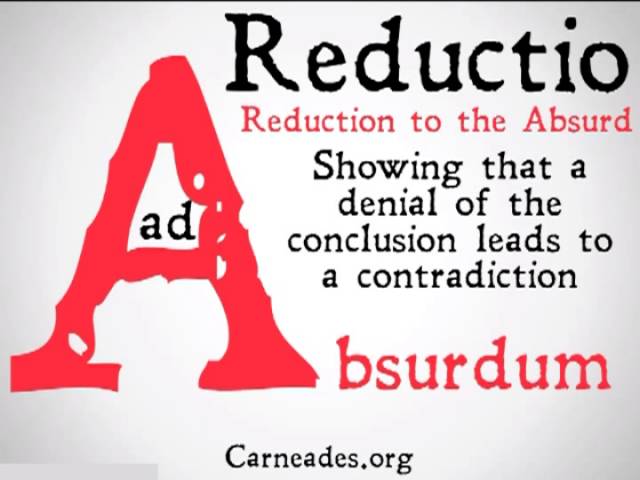
In this article I aim to demonstrate that Revelation 14:9-11 – as it is interpreted by those who believe hell is “eternal conscious torment” – leads to a logical contradiction, in fact a “reductio ad absurdum.”
Let’s first read the passage at hand so we can frame the discussion:
- “And another angel, a third, followed them, saying with a loud voice, ‘If anyone worships the beast and its image and receives a mark on his forehead or on his hand, he also will drink the wine of God’s wrath, poured full strength into the cup of his anger, and he will be tormented with fire and sulfur in the presence of the holy angels and in the presence of the Lamb. And the smoke of their torment goes up forever and ever, and they have no rest, day or night, these worshipers of the beast and its image, and whoever receives the mark of its name.’” (Rev 14:9-11)
The standard interpretation of this passage, by most evangelicals today is that it is all about the final judgment on sinners, resulting in their being cast into a fire that burns forever and them experiencing some form of physical or psychological torment forever. The important distinction here is that sinners “too,” will live forever.
The only distinction between the righteous and the unrighteous – in the “eternal conscious torment” view of hell – is the quality of life experienced. Some will experience eternal bliss and others eternal torment. Both will exist forever.
Ok now that we have set the stage, I would like to explain how most people interpret the Book of Revelation today so we can properly understand how passages are explained and understood.
Whilst there are four major schools of interpreting the book – “Futurist,” “Historicist,” “Preterist” and “Idealist” – most commentators I have reviewed actually end up holding to a mix of these views.
The important common denominator is that there is a consensus in one important factor. The book is not merely a sequential list of events, but rather a repetition of several major events, also called “recapitulation”. Whilst not all commentators accept this term, they pretty much all agree on the notion of repetition.
- “The order in which he saw things is not necessarily the historical chronological order in which those things will happen. This is clear from the fact the text shows he is speaking of the same events in different visions, but sometimes either not relating them in exactly the same order, or telling of different visions (e.g., horses instead of plagues) to express the same reality. Part of the reason for this is that, in general, the plagues recur throughout history, rather than being one-time historical events, hence there is not an exact correspondence in every detail.” (GK Beale)
It’s true, that commentators don’t all agree on all the details of repetition, but that is immaterial for our discussion, as you will see.
Then there is the issue of imagery. All interpreters correctly recognise – one does not have to be a rocket scientist here – that the book is filled to the brim with imagery that requires an interpretation.
Teaser: I am currently writing a book on the topic of hell with a final chapter on the book of Revelation. This article is based on some of the work in my book. I hope to have whet your appetite for the book, and perhaps you might support my work by buying the book when it is published later this year. More on that to follow.
What we can say so far is this:
- P1 - Revelation is a book of imagery that require an interpretation
- P2 - Revelation has events detailed by imagery that are repeated
- C - Revelation requires interpretation and the repeated imagery helps in the interpretation
So far, I think we can all agree on the premises and the conclusion definetaly follows from the premises.
Problems arise when some people view “some statements” in the book as facts, and others as images. This is what I would call a “partial imagery view”. We might distinguish interpreters like this:
- View A: Some interpret the book as all images requiring interpretation.
- View B: Some interpret the book as all images correspond to reality. {no one claims seven headed beasts actually exist!}
- View C: Some interpet the book as some images require interpretation, and some images correspond to reality.
My personal study of commentators of the book, has lead me to realise that even the most ardent followers of view (B) actually end up interpreting some parts of the book as view (C) after all, and I have not found a single commentator who interprets the book purely in the sense of view (A).
We are now left with the question as to how to arrive at, what is to be interpreted literally and what as imagery, and this is where there are as many different opinions as there are commentators.
Now back to the passage at hand we can say the following:
Either Rev 14:9-11 is:
- part of imagery of the book requiring an interpretation
- all imagery requiring an interpretation
- all fact stating a reality as is
One fact that literally all commentators agree on is the recapitulation on the event that this set of verses is framed in. GK Beale says it like this: “ The declarations concerning the fall of Babylon occurring in 14:8 and 16:19 and in various places in chs. 17-19 must also be describing the same thing, thus revealing again recapitulated description of judgment” (GK Beale)
Now let’s compare the material facts of the repetition of the event and then set the various methods of interpretation to the test. This is where the rubber hits the road.
The preceding verse of our passage, surely sets the stage for the event: “Another angel, a second, followed, saying, ‘Fallen, fallen is Babylon the great, she who made all nations drink the wine of the passion of her sexual immorality.’” (Rev 14:8)
The event is called “The Fall of Babylon,” and it matters not for our discussion when in history you believe this event took place, or whether it is in our future. It also matters not what exactly Babylon represents. Off course it matters universally, but not for the argument I am making here.
The same event called “The Fall of Babylon,” appears again in chapter 18, this time in much more detail. Let’s read it to get the context. (please read the whole chapter to get the context - I will highlight important sections here)
-
“Fallen, fallen is Babylon the great! She has become a dwelling place for demons… For all nations have drunk the wine of the passion of her sexual immorality, and the kings of the earth have committed immorality with her…”
-
“Come out of her, my people, lest you take part in her sins…, so give her a like measure of torment and mourning”
-
“For this reason her plagues will come in a single day, death and mourning and famine, and she will be burned up with fire; for mighty is the Lord God who has judged her.”
-
“And the kings of the earth, who committed sexual immorality and lived in luxury with her, will weep and wail over her when they see the smoke of her burning.”
-
“They will stand far off, in fear of her torment, and say, ‘Alas! Alas! You great city, you mighty city, Babylon! For in a single hour your judgment has come.’”
-
“And the merchants of the earth weep and mourn for her… The merchants of these wares, who gained wealth from her, will stand far off, in fear of her torment, weeping and mourning aloud.”
-
“For in a single hour all this wealth has been laid waste. And all shipmasters and seafaring men, sailors and all whose trade is on the sea, stood far off and cried out as they saw the smoke of her burning.”
(Rev 18:2-17)
Here are material facts - both agree on:
- In both chapters sinners worship the beast/city
- In both chapters the beast/city is burned
- In both events smoke goes up
Here are material differences:
- In chapter 14 the smoke goes up forever - leading interpreters to believe the fire goes on forever
- In chapter 14 the worshippers have no rest night or day
- In chapter 18 the city is burned up
- In chatpter 18 the event is finished in a single day and even in a single hour
- In chapter 18 sinners (of another category) watch from afar as the city burns - repeated twice
- In chapter 18 the event is not the end of all things
Here we can now make the following assertions:
According to view (A) {which incidentally very few people actually hold}
- P1 - The correct way to interpret the book is that it is all imagery requiring an interpretation
- P2 - The images in chapters 14 and 18 contradict each other in material ways
- C - It is false to inrepret the images in a way that would lead to a contradiction
According to view (B)
- P1 - The correct way to interpret the book is all images represent real events
- P2 - The images in chapters 14 and 18 contradict each other in material ways
- C - It is false to inrepret the images in a way that would lead to a contradiction
According to view (C)
- P1 - The correct way to interpret the book is that some things are imagery and some represents reality
- P2 - The images in chapters 14 and 18 contradict each other in material ways
- C - It is false the inrepret the images in a way that would lead to a contradiction
This seems very obvious, and should now help me to finally make my argument I set out to do:
Using the interpretational methods common to all schools of interpreting the book of revelation, namely that at the very least some of the images require an interpretation, and that events are repeated. It is logically absurd to claim that Rev 14:9-11 – the section that is commonly used to assert the “eternal conscious torment” view of hell – when the repetition of the event, quite literally denies the conclusion.
The astute reader, will now realise that I have not even attempted to interpret the images. That is true. My aim was not to make a positive claim as to what the imagery respresents. My aim was to hightlight that those who hold to a traditional view of hell, based at least in part on this passage in Revelation, do so whilst being at odds with their very own methods of interpreting the book.
That is what is commonly called a “Reductio ad Absurdum,” in logic. At the very least this should give us pause and alert us that our conclusions from the passage are false.
“Forever” as a term, is frequently used in a hyperbolic sense to depict a long time, but not in the sense that we have interpreted it from the book of Revelation.
Here are just a few examples, where the prophet Jeremiah is warning Judah of the impending punishment that is to come upon them, in the form of being taken into exile to Babylon.
We know from history that this event depicted as a “fire that shall burn forever,” actually only took 70 years to complete.
-
“Your wealth and your treasures I will give as spoil, without price, for all your sins, throughout all your territory. I will make you serve your enemies in a land that you do not know, for in my anger a fire is kindled that shall burn forever.” (Jer 15:13-14)
-
“You shall loosen your hand from your heritage that I gave to you, and I will make you serve your enemies in a land that you do not know, for in my anger a fire is kindled that shall burn forever.” (Jer 17:4)
“Day and night” is yet another term frequently used in Old Testament prophecy, in a hyperbolic sense to dramatise and evoke shock, rather than to mean literally never ending.
In this example Isaiah has prophesied against Edom who cheered on as the Babylonians took their kin – the people of Judah – into captivity. The doom prophesied on the Edomites, comes to them from the Nabeans, within a 100 years.
- “Night and day it shall not be quenched; its smoke shall go up forever. From generation to generation it shall lie waste; none shall pass through it forever and ever.” (Isa 34:10)
Here in this verse we have all the same ingredients as in Rev 14:9-11, and yet the passage in Isaiah – as is commonly recognised by scholars and historians – refers to a real event, in history that occurred now nearly 3 millenia ago.
Just to fill in some historical blanks. The land of Edom was not left to lie in waste forever. The doom came as foretold, but the nation of Edom recovered, at least somewhat. We know this from the New Testament, since Herod – an Edomite – ruled over the nation of Judea in the days, Jesus was born.
We can formulate the following argument:
- P1 - “Night and day” and “forever and ever” are commonly used by Old Testament prophets
- P2 - These terms are used in depictions and foretelling of real historical, actual events
- C - Interpreting these terms in a wooden literal sense, leads to “reductio ad absurdum”
In my book I go into great detail of how each of the phrases in verses 9-11 are used in the prophetic writings of the Old and New Testaments. I also look at how dreams and visions are commonly interpreted in the Old and New Testaments broadly, and what language devices point to where we can find the moment the author of the Book of Revelation, actually gives us the interpretation of this difficult passage.
In the meantime, I hope to have whet your appetite.