Templates for Christian Experience
Are Biblical Narratives meant to be templates for Christian Experience?
2026-10-01 by Steve Forkin
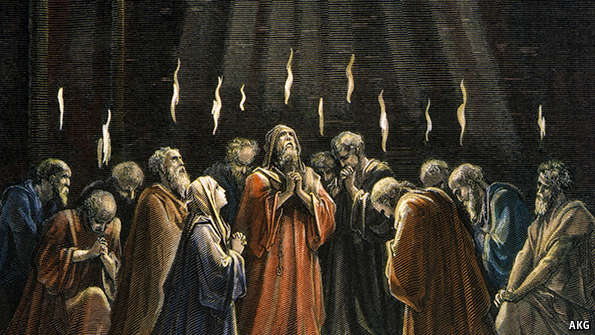
The Pentecostal & Charismatic denominations are the ones who press the hardest on the notion of Christian experience. Importantly, the giving the Holy Spirit on the Day of Pentecost is turned into a de-facto & universal template for all believers in all times and places.
Templates for Christian Experience
Are Biblical Narratives meant to be templates for Christian Experience?
Having grown up in the Pentecostal movement, I used to be convinced that Acts chapter two was the de-facto template for all believers, and that in fact all believers were meant to experience the giving and receiving of the Holy Spirit in the exact same way as the early Apostles and Disciples did.
Sadly, the theology behind this idea is firstly driven by the experience itself and only secondarily by the actual passages of scripture that are turned into a template.
At some point in my Christian journey I started to ask myself some hard questions, amongst them also the question of “Is what I have experienced in the Pentecostal world actually what is described in the New Testament?” or could it be that I had a certain experience and thereafter sought for Bible passages that fit the experience. Could it further be that the experiences didn’t actually fit the Bible passages, which raised even more questions.
I believe – having had opportunity to chat with many people who started their Christian journey in one of the many Pentecostal or Charismatic churches – that many are too afraid to actually ask the hard questions, given the depth & breadth of the experiences, people consider it unthinkable that they might have experienced a form of Psychological phenomena quite unrelated to scripture.
For many this is a bridge too far. Frightened, they continue on the same journey. For some, like me the experiences just did not add up, so question we must.
My journey of questions relating in particular to the “Gift of Tongues” ended up, with me writing a book on the subject. If you have questions on this subject, can I recommend you buy the book? That is certainly one way you can support my ministry here on substack.
https://www.amazon.com.au/Speaking-Tongues-Authentic-Strange-Fire-ebook/dp/B0C62ZM8ND
If you are anything like me, when someone says, “this is the right method of Biblical interpretation”, I immediately ask, “How so?”
I have been to Seminary, and completed a masters in Theology and Apologetics. I am well aware of the science of biblical interpretation, having studied it in-depth. But, I am also desirous to be a lay person when I read scripture as I firmly believe scripture has been written in a way that all believers can understand the important parts, given the use of the right tools and methods of interpretation.
The hard question we must therefore ask again and again, what is the right way to interpret scripture? Apart from the plain logic behind the notion that “meanings of terms are determined by their use within the context they are written in,” what other specifics can we actually derive from the text of scripture itself?
Btw, I never cease to be amazed by lay people and serious theologians alike who are willing to “import” the meaning of terms used in another context, when the plain meaning of them, jumping out from the context of the passage does not seem to fit the pre-conceived idea – often derived from a particular denominational bias – or docrine. We are all subject to the desire to press our particular denominational bent onto a passage of scripture, especially those who claim to never do this.
The issue in this article is the one of “experience of receiving the Holy Spirit” as per the Book of Acts chapter 2:1-4. The very basics of Pentecostal Theology stipulates that the way the 120 disciples waiting in the Upper Room, for the sending of the Holy Spirit – as foretold by Christ, the Messiah, is the way believers today, can and should receive the Spirit.
The claim here is that this day or moment in the life of the church is the defacto template for all believers. Some Pentecostals – those of the more extreme kind – claim that in order to be saved one must Speak in Tongues, just like those in the Upper Room. The more mainstream view is that this a second order experience, they call the “Baptism in the Holy Spirit”.
Regardless, what we have in Acts two, is the universal template for Christian experience, they say. Two immediate problems arise from this and they are encapsulated in the following two questions:
- Firstly, the passage in Acts does not at all make the claim that this was a universal template for Christian experience
- Secondly, even if it was, the Book of Acts itself appears to suggest otherwise, which is I think an unsurmountable hurdle
If you are unsure, please don’t take my word for it, simply read the three events in the Book of Acts where we have actual details of how people received the Spirit and see whether the template – so-called – fits.
Here are the material facts of the giving & receiving of the Spirit in Acts 2:
- All the disciples were praying together
- No one laid hands on them
- They all received the Spirit in the same way
- They all spoke in Languages – “Tongues” is simply an old English word that has remained in most English translations. The Greek word used “Glossa,” is basically what we would call today “Language.” This is a fact that should immediately raise questions in the seeker. The context of the passage in Acts 2 spells this out wonderfully and easily for the person willing to look. None of the disciples did what people in Pentecostalism do today.
- A careful student will further notice that each of disciples had what appears to be a “flame of fire” on or above their heads. This is missing in the modern version.
- Finally they experienced “sound like a rushing mighty wind.” Again, this is isn’t in from the modern version.
- Moving on to the Acts chapter 10. A careful student will or should arrive at the clarity that the household of Cornelius experienced the exact same thing as the first disciples did
- Finally moving on to Acts 19 we see that all those who received the Spirit also prophesied. Wooden literalism does not help the Pentecostal position here. Either all prophesied – making prophecy a part of the template or all did not prophecy [the word all might simply suggest that they all as a group did.?]. If all did not prophecy then off course we are perfectly right to suggest that also all did not speak in languages.
- Notice also here that the modern version of tongues is entirely missing in action in the Book of Acts, no pun intended.
The Book of Acts was written by Luke, one of the travelling companions of the Apostle Paul. It’s likely Luke, was even with Paul when he wrote to the Corinthians, the first letter that has the other passages on the gift of tongues – chapter 12 being the one that causes the biggest problem for the template theology paradigm. A careful reading of the giving of the gifts of the Spirit and the rhetorical questions Paul asks, leaves the honest student in no doubt. This once again, provides what I again would suggest, is an unsurmountable hurdle for Pentecostalism.
Having said all that, I am still left with this lingering question, “Are Bible Storeis meant to be templates for our experience?”
Here I would like to draw on two defining moments in the broader history of God’s people and whilst these passages don’t directly answer the question, they do very strongly suggest what the answer must be. This again shows that the Bible is an amazing book that gives us all the tools in its own pages on how we should correctly understand it.
Let’s dig in.
Narrative 1: “The Giving of the Law”
- “How on the day that you stood before the Lord your God at Horeb, the Lord said to me, ‘Gather the people to me, that I may let them hear my words, so that they may learn to fear me all the days that they live on the earth, and that they may teach their children so.’ And you came near and stood at the foot of the mountain, while the mountain burned with fire to the heart of heaven, wrapped in darkness, cloud, and gloom. Then the Lord spoke to you out of the midst of the fire. You heard the sound of words, but saw no form; there was only a voice. And he declared to you his covenant, which he commanded you to perform, that is, the Ten Commandments, and he wrote them on two tablets of stone.” (Deut 4:10-13)
Let’s turn the idea that Bible narratives are templates for experience into a sylogism. It will immediately become apparent that this is an erroneous way to interpret scripture.
- P1 - Bible stories are at least sometimes templates for universal experience
- P2 - If this is true that at least the major-event/Bible stories should affirm P1
- P3 - The Giving of the OT Law is perhaps the single most important and universal event in the whole of the OT
- P4 - The way the Israelites received the 10 Commandments on Mount Sinai is never repeated
- C - P1 is very likely the wrong way to interpret scripture.
Notice here that I have been at least somewhat generous by reducing P1 to “sometimes” and I think based on this P2 is a reasonable deduction. Notice also that the giving of the law was miraculous and universally applicable. Here I would suggest you read the parallel passages in Exodus 19, 20 and onwards to get the bigger picture. Jews broadly, still believe today that this was the most significant of all the miracles given in the Old Testament – second perhaps to the act of creation itself. The Exodus story is the defacto definitional event in the story of Israel and the Jewish people.
Yet, what we all intuitively and immediately recognise is this. All Jews understand that the law was given to them all, throughout history, yet the experience of receiving the law is not at all a template.
Please note what the Apostle Paul tells us about the universal applicability of the law, in his letter to the Romans. Read the entire chapter two to get the bigger picture.
- “..all who have sinned under the law will be judged by the law..” (Rom 2:12)
Narrative 2: “The Giving of the King”
Second, perhaps in significance and certainly in universal applicability, was the experience of being given a King to rule over Israel. We see how this unfolds, after the book of Judges, where the sinful state of Israel becomes worse and worse, ever more turning aside to their own ways. God’s design for his people was for each individual to be under God, submitted to his Holy Law. Additionally, God provided prophets & judges for his people, acting as what we might call “the sword of justice” for the times of much needed Spiritual correction and discipline.
Then the children of Israel demand a King to rule over them. They want a worldly king who will fight their battles for them. They quite literally refuse to trust in power of almighty God. The result is disastrous for them.
- “Then all the elders of Israel gathered together and came to Samuel at Ramah and said to him, ‘Behold, you are old and your sons do not walk in your ways. Now appoint for us a king to judge us like all the nations.’ But the thing displeased Samuel when they said, ‘Give us a king to judge us.’ And Samuel prayed to the Lord. And the Lord said to Samuel, ‘Obey the voice of the people in all that they say to you, for they have not rejected you, but they have rejected me from being king over them. According to all the deeds that they have done, from the day I brought them up out of Egypt even to this day, forsaking me and serving other gods, so they are also doing to you. Now then, obey their voice; only you shall solemnly warn them and show them the ways of the king who shall reign over them.’ So Samuel told all the words of the Lord to the people who were asking for a king from him.” (1 Sam 8:4-10)
Contrary to God’s original design, God gives what the people want and instructs the prophet to give them the details they likely did not want to hear..
- “He said, ‘These will be the ways of the king who will reign over you: he will take your sons and appoint them to his chariots and to be his horsemen and to run before his chariots. And he will appoint for himself commanders of thousands and commanders of fifties, and some to plow his ground and to reap his harvest, and to make his implements of war and the equipment of his chariots. He will take your daughters to be perfumers and cooks and bakers. He will take the best of your fields and vineyards and olive orchards and give them to his servants. He will take the tenth of your grain and of your vineyards and give it to his officers and to his servants. He will take your male servants and female servants and the best of your young men and your donkeys, and put them to his work. He will take the tenth of your flocks, and you shall be his slaves. And in that day you will cry out because of your king, whom you have chosen for yourselves, but the Lord will not answer you in that day.’ But the people refused to obey the voice of Samuel. And they said, ‘No! But there shall be a king over us, that we also may be like all the nations, and that our king may judge us and go out before us and fight our battles.’” (1 Sam 8:11-20)
Here it is important to note that whilst this experience does not result in a miracle they all see, but it does result in the next King – King David – being a Godly king who does show forth God’s power and shows them how righteousness does indeed exalt a whole nation. The ongoing history of the Kings of Israel and Judah, is a very mixed bag. There are some good kings – during whose reign there are times of universal reformation and revival, and yet many of the kings quite literally are the cause of the descent into terrible sin and the eventual wars with Assyria and Babylon resulting in the second exile.
Whilst this second example isn’t as obvious – in a more personal sense – as the giving of the law, it does also make my earlier observation quite clearly.
Biblical Stories or Narratives are not meant to be turned into templates for Universal Experience
- The “Giving of the Law” was accompanied by a spectacular miracle that was experienced universally by all of Israel at the time, yet later generations did not experience the law in this way, they simply had the law presented to them. It’s applicability did not depend on the experience.
- The “Giving of the Holy Spirit” was too accompanied by a spectacular miracle that was initially experienced by all the disciples. Nowhere in the Book of Acts, are we told this experience is a universal template for all believers from there on. The actual accounts in the remainder of the Book of Acts, whilst not denying this notion, do not bear this idea out either. The most powerful evidence to the contrary of this notion of universal experience, comes in the form of Paul’s letters to the Corinthian church.
If, as the Pentecostal Theologians want us to believe, Acts 2 is a template for the Baptism of the Holy Spirit, then those receiving it today should experience the same thing, and the Pauline letters need to be seriously redefined. These two issues stand quite like a brick wall in the way.
Perhaps as a final comment, I am reminded of the many Pentecostal and Charismatic claims that modern believers are to be miracle workers just like Jesus. The idea is that since Jesus could and did those miracles, we should likewise be able to. I have written at length about the reasons why this is the wrong way to read the gospel accounts of the life of Christ. The hardest brick wall – here too – is what I would call reality. When Pentecostals and Charismatics get sick, really sick, and they pray just like all other believers tend to do when faced with sickness. That is when the rubber hits the road. That is the litmus test of sound Biblical theology correctly applied. Often it is sickness experienced, endured and walked through, that causes people who have bad theology to adjust and re-read scripture.
At no point in this article did I want you to get the idea that Pentecostals are not true Christians. I was merely trying to evaluate their claims against the text of scripture, in the hope that this might help people to refocus on Christ and Christ alone!